Indian Scientists Become First to Prove Quantum Measure Can Exceed One
Researchers in India have experimentally confirmed a counterintuitive rule of quantum physics, showing that a key measure of interference can go beyond its classical limit.
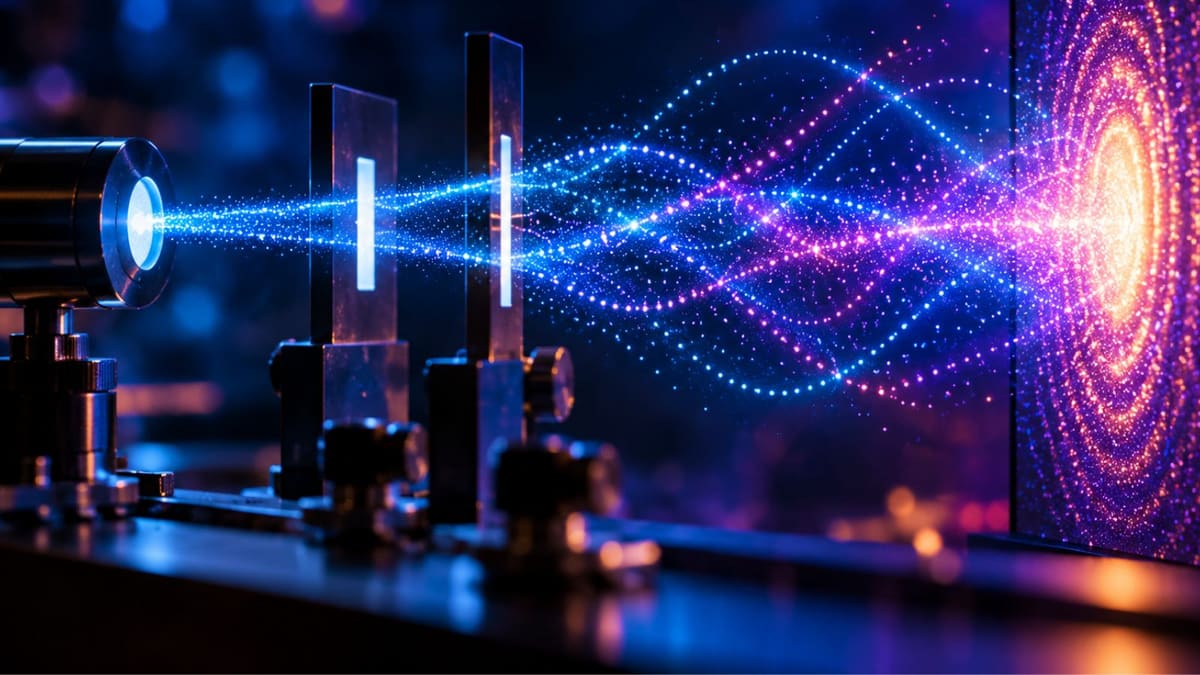
Physicists in India have achieved a global first by proving in the laboratory that a quantity known as the "quantum measure" can exceed the value of 1. The breakthrough experiment, carried out by researchers associated with the Raman Research Institute (RRI), sheds new light on how particles behave at the smallest scales of nature.
In everyday physics, probabilities and measurements behave predictably: if you combine independent paths or outcomes, they add up neatly within fixed boundaries. In the quantum world, however, tiny particles like photons and electrons behave like waves that can overlap, cancel each other out, or amplify one another in ways classical physics cannot explain.
Understanding the Quantum Measure
The "quantum measure" is a mathematical tool physicists use to test how far quantum systems stray from ordinary classical probability. In classical physics, this measure stays capped at or below 1. For years, theorists predicted that under specific multi-path interference setups, quantum mechanics allows the value to climb above 1.
Proving that prediction in a real experiment required extreme precision. Researchers had to control delicate light pathways and eliminate tiny vibrations or stray light that could ruin quantum interference before detectors could record it.
Why Fundamental Quantum Research Matters
While this experiment is about fundamental physics rather than an immediate consumer gadget, understanding the exact boundaries of quantum behaviour is essential for emerging technologies. Quantum computing, ultra-secure communications, and next-generation medical sensors all depend on harnessing interference reliably.
- The breakthrough: Indian researchers achieved the first experimental proof that a quantum measure can exceed 1.
- What it tests: How strongly quantum particles violate classical rules of probability during multi-path interference.
- Why it matters: Tighter experimental control over quantum states strengthens the foundation for future quantum computing and sensing systems in India.
The result also highlights the growing strength of Indian research institutes in experimental quantum optics, complementing the country's wider National Quantum Mission.