Astronomers Spot Rare Triple-Star System With Two White Dwarfs Near Earth
Scientists have discovered an unusual nearby star system made up of two white dwarfs and a red dwarf, offering a rare window into how stars age and interact.
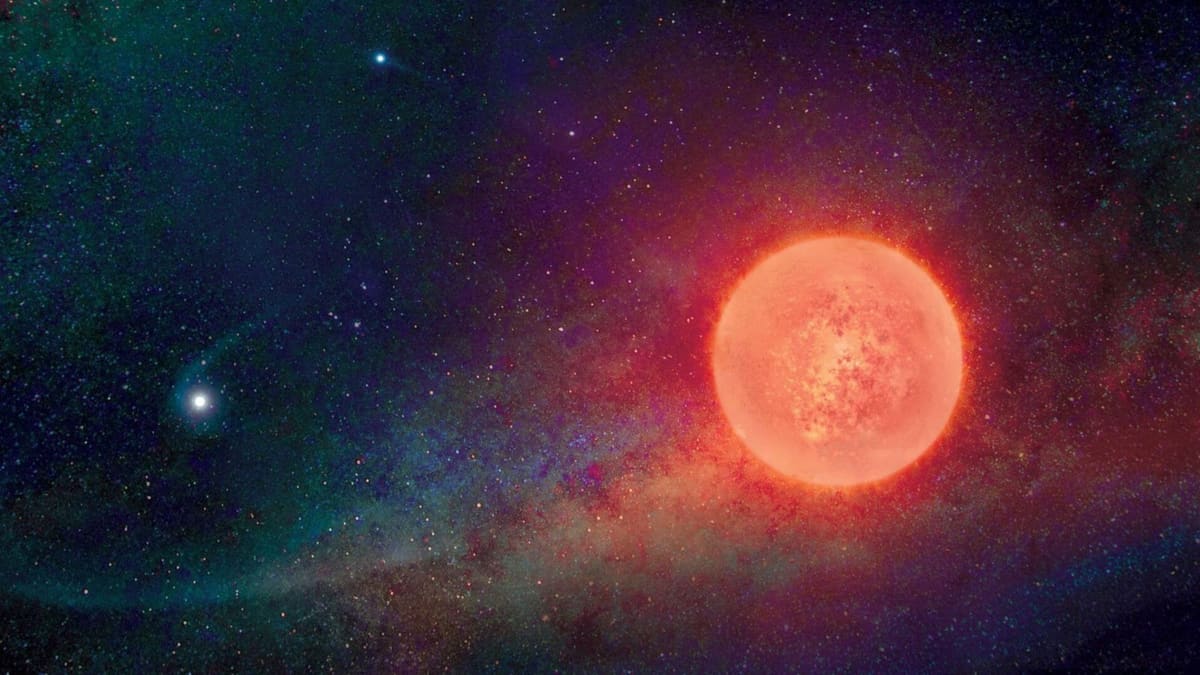
Astronomers scanning our cosmic neighbourhood have discovered a rare and puzzling star system relatively close to Earth. Instead of a single sun like ours, this system brings together three very different stars locked in orbit: two white dwarfs and one red dwarf.
Triple-star systems are not unheard of in our galaxy, but finding two burned-out stellar remnants paired alongside a small, still-shining red dwarf so nearby is unusually rare. Because the system sits close to Earth in astronomical terms, telescopes can study its motion and composition in far greater detail than distant galaxies.
What White Dwarfs and Red Dwarfs Are
A white dwarf is what remains after a star similar in mass to our Sun runs out of nuclear fuel, sheds its outer layers, and leaves behind a dense, Earth-sized core that slowly cools over billions of years. A red dwarf, by contrast, is a much smaller, dimmer, and cooler star that burns its fuel so slowly it can shine for trillions of years.
Having two white dwarfs in the same system means two stars have already lived out their main lifetimes and transformed, while their smaller companion is still steadily burning. Studying how those three stars avoided colliding—or how they transferred gas to one another as the larger stars swelled into red giants—helps astronomers refine models of stellar evolution.
Clues About the Fate of Multi-Star Systems
Most stars in the Milky Way form with companions rather than alone. Systems like this newly discovered trio act as natural laboratories for testing how gravity shapes tight multi-star orbits over billions of years.
- The discovery: A nearby triple-star system containing two white dwarfs and one red dwarf.
- Why it is rare: Finding two evolved stellar remnants alongside an active red dwarf close to Earth gives astronomers crisp observational data.
- Scientific payoff: Helps scientists understand mass transfer, binary star evolution, and how multi-star orbits stay stable.
Astronomers plan follow-up observations using space and ground telescopes to measure the exact masses and ages of all three stars in the trio.