Harvard's Tiny UV Light Chip Could Help Shrink Future Quantum Computers
Researchers led by Harvard have built a microscopic optical device that converts red light into ultraviolet light far more efficiently, paving the way for smaller quantum machines.
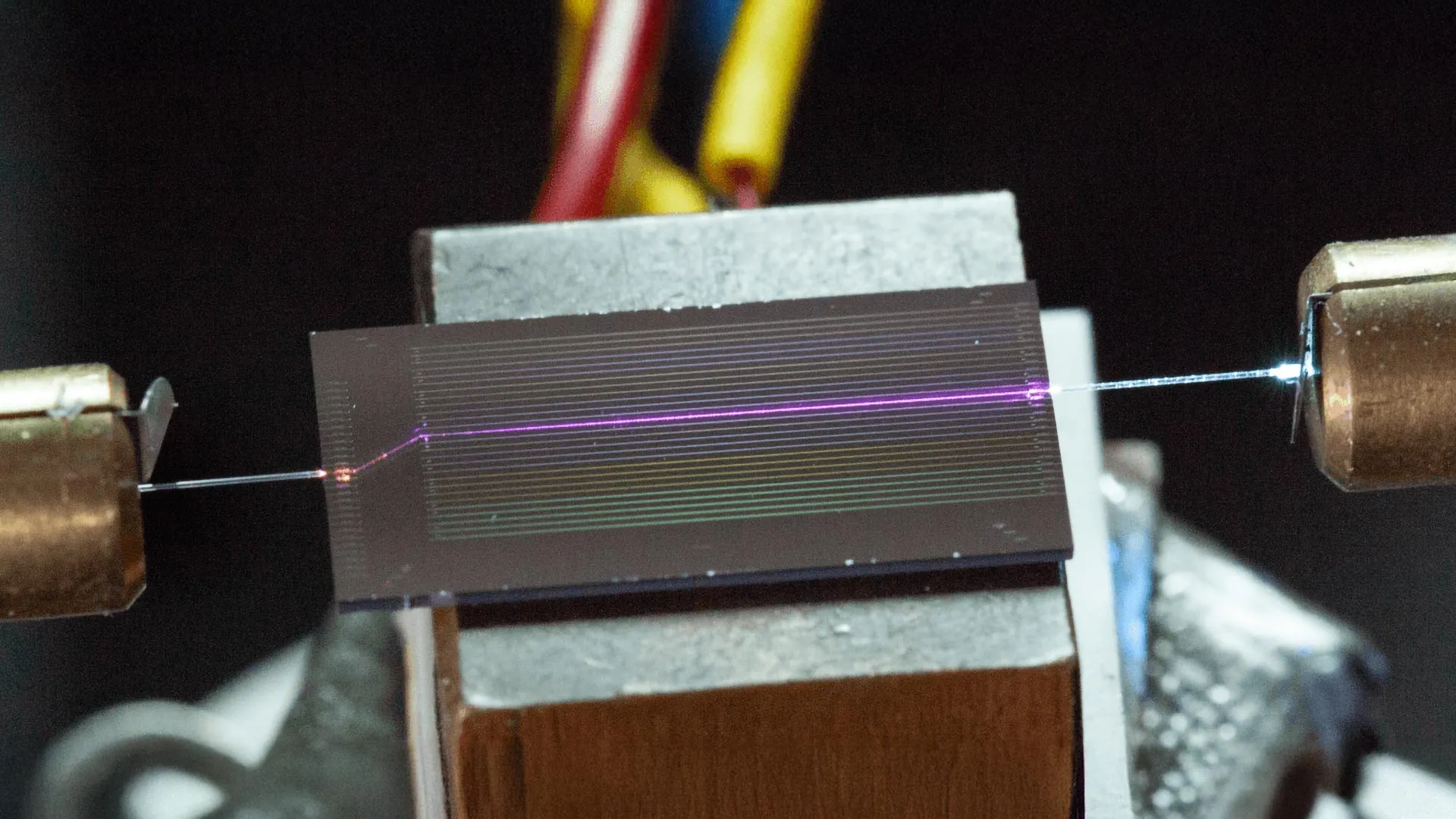
A research team led by scientists at Harvard has created a microscopic chip component that could make future quantum computers much smaller and easier to build. The tiny device takes ordinary red laser light and converts it into ultraviolet light, producing 120 times more UV output than comparable earlier designs.
Ultraviolet light plays a crucial role in many advanced physics labs, especially in quantum systems that rely on trapped atoms or ions to store and process information. Until now, generating stable UV light at the right wavelengths often required bulky, expensive tabletop lasers and complex mirrors.
How the Microscopic Device Works
Instead of relying on large optical equipment, the new approach shrinks light conversion onto a sliver of material small enough to fit on a microchip. By carefully guiding red light through tiny engineered structures on the chip, the device shifts the light's energy upward into the ultraviolet range with remarkably little waste.
Achieving a 120-fold jump in UV output on a chip solves one of the biggest bottlenecks in miniaturizing optical hardware. Because the device starts with common red light sources that are already compact and reliable, engineers do not have to build miniature UV lasers from scratch.
Why This Matters Beyond Quantum Computing
Shrinking optical hardware could bring quantum computers out of room-sized laboratory setups and closer to practical, scalable machines. It may also benefit ultra-precise atomic clocks, medical imaging tools, and microchip manufacturing, all of which depend on tightly controlled ultraviolet beams.
- Major efficiency leap: The chip produces 120 times more ultraviolet light from red light than previous comparable micro-devices.
- Smaller footprints: Replacing bulky tabletop lasers with chip-scale parts helps make quantum hardware more compact and portable.
- What happens next: Engineers will work on integrating the UV light converter directly with other quantum chip components for real-world testing.